No matter what you want to knit, the first step towards machine knitting is to cast on. Followed by much to-ing and fro-ing, then cast off. Keep reading for the How To Cast on and How To Cast Off guide for beginners, to show how quick and simple machine knitting is. By the end of this page, you will be able to make as many scarves as you like 🙂
The knitting machine being used for the guide is the Brother KH-940 without the ribber attached, and acrylic 4 ply yarn. If you are using acrylic, and the single bed, like this example, the finished product will have rolled edges, pressing will fix that. We will assume you have some documentation regarding how to thread your particular knitting machine and have threaded it. For casting on, the “simple cast on” will work on Brother knitting machines and the “e” wrap method should work on the majority of Japanese machines eg. Brother, Singer, Toyota and Empersal. Passap knitting machines use a different method which will be covered in the Passap pages.
I find using photos and videos as a learning tool easier than a whole lot of writing, so I have included them also.
Learn how to cast on
Simple Machine Knitting Cast On
Move your K-Carriage to the right of the needle bed (knitting carriage, the bit you grab onto and move side to side to knit). Locate all the needles to the A position (positions are marked on each side of the needle bed). Click your weaving brush levers into the up position.
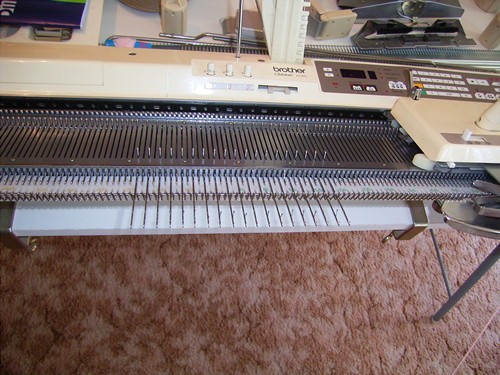
Working from the center (so the counter works reliably) push every needle for your required width (the width of the finished product will be smaller that the width the needles represent) to the B position. Now push alternate needles to position E (all the way out). Pull your pre threaded yarn from under the K-Carriage, across the E needles, resting it in front of the bed but behind the hooks of the needles. Angle the end of the yarn you are holding down and away from the K-Carriage.
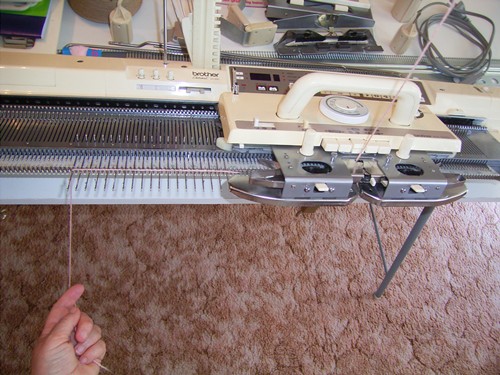
Be sure to hang onto the end, not pull tight, just don’t let it go. Slide the carriage from right to left, it might feel like things aren’t right, but it should go fairly easily, slide it until you have cleared the pushed out needles.
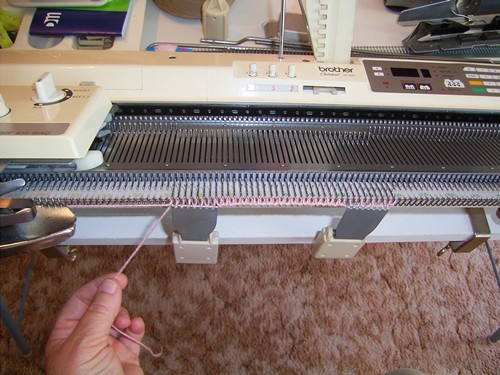
The carriage will move the needles automatically so don’t panic that they aren’t in the same position as where you left them. Keep holding the end of the yarn and move the carriage back to the right, once again moving all the way past the moved needles.
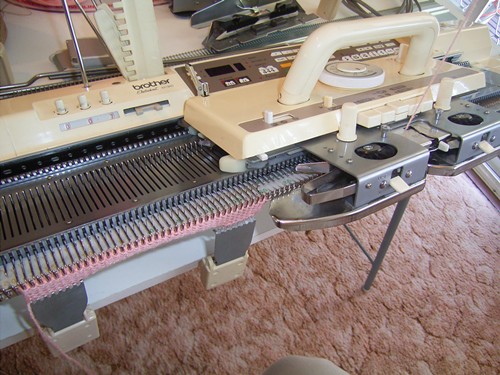
Guess what? You have cast on! Keep a grip on the end of the yarn for another couple of rows. Return the weaving brush levers to the down position, now is also a good time to add some weights to the emerging knitted product to keep an even tension on it. Try using a cast on comb if you have one. Uneven tension makes the finished product knit unevenly with some holes larger than others. If you don’t have any weights, pull lightly downward on the knitted article as you knit so it doesn’t drop stitches due to the lack of downward pressure keeping the yarn on the needles.
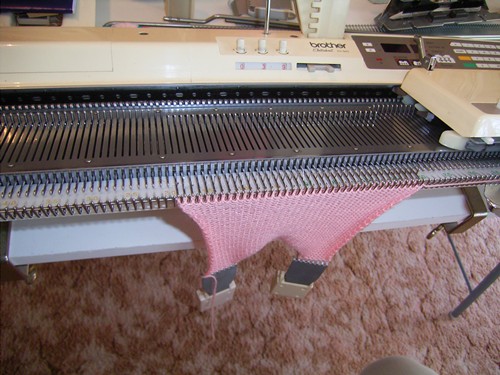
This simple cast on is great for making quick swatches of machine knitted fabric to assess the tension and also the number of stitches and rows required to create a finished article from a particular yarn, the results do vary from yarn to yarn.
Learn how to “e” Wrap Cast On
Named from the shape the yarn makes on the needles, it gives a nicer finish, but is a bit more fiddly. Putting this process into words may come later, but I find it easier to see whats going on rather than read it. Simply click the play button below to see e wrap casting on being performed.
Learn how to cast off
Simple Machine Knitting Cast Off
Once again, a text translation may come after, but for now, the video below will give a visual guide to a simple machine knitting cast off.
Looser Machine Knitting Cast Off around gate pegs
This method of casting off produces a nicer finish more reliably keeps a uniform tension. It achieves this by keeping the but the stitches you are casting off on the knitted article on or near its needles on the gate pegs that protrude from the front of the bed. The result is the article cannot bunch up or fall down, pulling the yarn unevenly.
the videos are too blurry and far away to actually see what you are doing : ( i guess i need one on one, in person training. but just letting you know in case you want to try and make this better 🙂 thanks…
do you know of any instructionals on the casting off that are a series of images (either photos, or illustrations) ?
in conjunction with the videos, this may be helpful.
thanks again!!
I will try to grab some higher resolution videos and a series of photos this week.
Thanks for the input! 🙂
found the videos for casting on and off very useful. thanks. keep up the good work. sincerly BJ
great website came in very useful keep up the good work. cheers Sheila
Thanks for visiting!
Just got a second hand Brother KH-900 as a Xmas gift from my children. I had forgotten how to use a knitting machine, but found your cast on method helpful and informative. Would have liked to found some info about how to use and program the KH900. Maybe soon.
Anyway, thanks again for you helpful page and keep up the good work!!!
Hmm, I might have to look into a simple programming guide page, thanks for the tip!
seems you’re well on the way to winning friends and influencing people… in a tremendous way!… erm, you could go even further if you managed to find and post links to the great variety of machines that are haunting hall cupboards, sheds, under house storage areas and attics because we’ve forgotten how to use the darned things! thanks for a great site… keep up the good work!
You should at the very least explain what you’re doing in the videos as you’re doing it. The video quality isn’t great, especially with the light on such a soft color and I honestly have no idea what you’re doing to cast off in either of the videos.
Hi Amanda,
I am looking into an HD video camera that can do slow motion so the process can be slowed down. Also, as my mother is the machine knitting guru whose hands you see, I actually watch the videos myself later and try to explain them in my own words (as I know very little about machine knitting) so beginners can follow. I have yet to do this for these videos. Sorry they aren’t clear enough but I am hoping to improve them. Cheers.
Hiya
I have just picked up a Brother KH860 knitting machine and I’m wanting to cast on and have a go.
Just looked at your video and it was helpful but we can’t see the settings on the carriage and therefore are having trouble casting on.
I was wondering if there was any chance of a few more instructions
Hi Susan,
I will do my best to get some bettter footage an photos. If only I could teach my mother to update this website herself….. 🙂
What an ungrateful bunch of people commenting, you put up free videos & they have the check to complain about them.
Some people are just so rude & expect perfection for nothing
Keep up the good work, some of us appreciate it
Hi Susan,…I’ve been trying to cast on my new (to me) KH 830 and I am so excited to see how to do it. Thank you so much for the VERY clear instructions. By the way, it is very clear. Thank you. Thank you.
Carmeen
Ciao a tutti questo articolo è molto interessante grazie.
I just found your video while trying to figure out all I have forgotten from my last lesson! these are helpful but like others commented, camera work needs some help and would be very helpful if your mom could SLOW DOWN! She is good she can go fast but it is very difficult for inexperienced beginners to actually she how she is doing things! My instructor does the same thing but I can ask her in person to go step by step so I can understand better.Thanks for doing this for us.
Thanks Gayle, glad you liked it!
http://machineknittingetc.com/brother-knitking/machine-manuals.html
To the ladies who got the KH-900 and KH-860 knitting machines and are just starting: above please find the website where you can download all manuals in pdf.
Hope that helps.
I was blessed with an Empisal knitting machine and just by looking at it, is scary. I know absolutely nothing about the machine or how to start. By watching your video and inout, I feel I can do this, and to me this is a great gift you have to inspire other woman. Thank you.
Just found your site, and watched cast on, cast off videos. Thank you so much, every little bit helps when you are a brand new machine knitter!